Artificial Intelligence (AI) is no longer limited to computer science labs or technology companies. It shapes how we search for information, communicate, learn, and make decisions every day. For today’s students, AI is not a future topic — it is part of their present reality.
That is why AI literacy should not be taught as a separate or optional subject, but as a cross-curricular competence embedded across all areas of learning.
AI literacy is not about coding
When people hear “AI education,” they often think of programming, complex mathematics, or technical training. In reality, AI literacy is about understanding, not building systems.
AI literacy helps students:
- understand where AI appears in daily life,
- recognise its limitations and risks,
- question automated decisions,
- and use AI tools responsibly.
These skills are relevant to every subject, not just technology classes. Just as reading literacy supports learning in all disciplines, AI literacy supports students in navigating a world shaped by digital systems.
AI affects every area of knowledge
AI already interacts with content across the curriculum.
In language and literature, students encounter AI-generated texts and automated translation. They need to understand authorship, originality, and meaning.
In history and social studies, AI raises questions about power, surveillance, and social impact.
In science, AI is used to analyse data and model systems.
In art and media, AI influences creativity, image manipulation, and visual storytelling.
In civic education, AI affects democracy, privacy, and participation.
Treating AI as a standalone topic ignores its real influence. Students need tools to reflect on AI where it actually appears — across subjects and contexts.
Learning through stories and visuals
One of the challenges of teaching AI literacy is that many concepts feel abstract or invisible. Algorithms, data, and automated decisions are often hidden behind screens and interfaces.
This is where comics become a powerful educational tool.
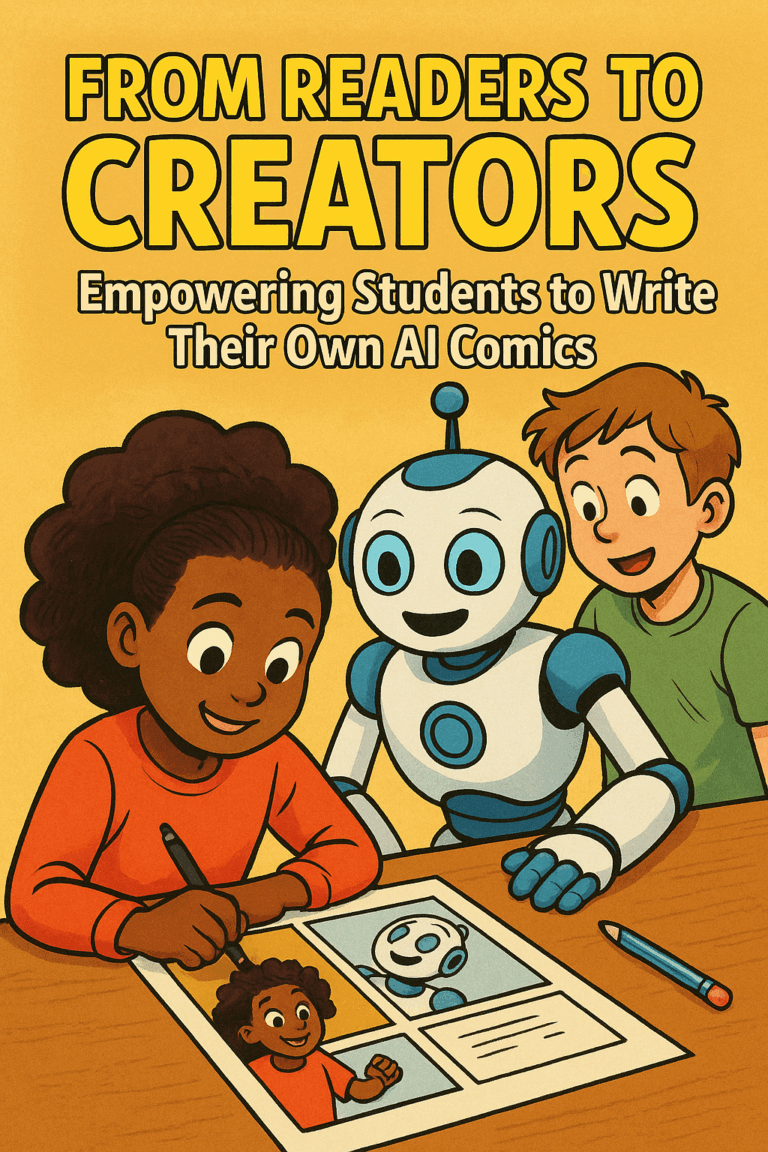
Comics translate abstract ideas into stories, characters, and situations that students can relate to. Instead of explaining AI in technical terms, comics show:
- how a system makes a decision,
- what happens when data is incomplete or biased,
- how humans interact with technology,
- and why responsibility still matters.
By combining visuals with narrative, comics make AI concepts concrete and accessible — especially for students who may feel excluded by traditional, text-heavy explanations.
Comix4AI: a cross-curricular approach
The Comix4AI project is built on the idea that AI literacy should be inclusive, engaging, and interdisciplinary. Through digital and interactive comics, Comix4AI supports teachers in introducing AI-related topics in different school subjects without requiring technical expertise.
A comic scenario can be:
- analysed in a language class for narrative and perspective,
- discussed in social studies for ethical and societal impact,
- explored in ICT lessons for digital systems and decision-making,
- or used in art classes to reflect on visual communication and creativity.
This flexibility allows teachers to adapt AI literacy to their subject area while maintaining a shared educational goal: helping students understand and question technology.
Supporting critical thinking, not passive use
One of the risks of AI in education is that students may begin to rely on automated tools without reflection. AI literacy counters this by encouraging critical engagement.
Using comics, students can:
- identify where AI influences decisions,
- compare human and automated choices,
- discuss consequences and alternatives,
- and reflect on fairness, responsibility, and trust.
Rather than teaching students to accept AI outputs, this approach teaches them to ask questions — a skill that belongs in every subject.
Empowering teachers across disciplines
Many teachers worry that teaching about AI requires specialised knowledge. A cross-curricular approach supported by creative tools helps reduce this barrier.
Comics provide:
- a shared starting point for discussion,
- a safe space for exploring complex issues,
- and an accessible way to introduce AI concepts without technical overload.
Projects like Comix4AI empower teachers to integrate AI literacy into their existing curriculum, rather than adding another separate topic to an already full schedule.
Preparing students for real-world citizenship
AI literacy is not only an educational goal — it is a citizenship skill.
Students will grow into adults who vote, work, communicate, and create in AI-supported environments. Understanding how technology influences information, choices, and opportunities is essential for democratic participation and personal autonomy.
By embedding AI literacy across subjects, schools help students develop a holistic understanding of technology’s role in society — not as users, but as informed citizens.
Final thoughts
AI literacy belongs in every school subject because AI shapes every part of modern life. Teaching it only in technical contexts limits understanding and excludes many learners.
By using storytelling and comics, projects like Comix4AI show that AI literacy can be accessible, engaging, and meaningful across the curriculum. When students learn about AI through stories, discussion, and reflection, they are not just learning about technology — they are learning how to live with it responsibly.
Education does not need more technology for its own sake. It needs better understanding, guided by human values — and that is exactly what cross-curricular AI literacy can offer.